

Tesamorelin
Tesamorelin
Couldn't load pickup availability
Tesamorelin
Get it as soon as -
30 Day Trial
30 Day Trial
We're confident you'll be happy with your order! In case things don't go as planned, you have 30 days to request a refund based on our return and refund policy.
Shipping & Processing
Shipping & Processing
Our shipping services are designed to be fast and reliable, ensuring your order is delivered promptly. Please allow 5-10 business days for delivery.
Track My Order
Track My Order
Once your order is shipped, we will provide you with a tracking number to monitor the progress of your shipment on our website or the shipping carrier's website. You can track your order here Track My Order
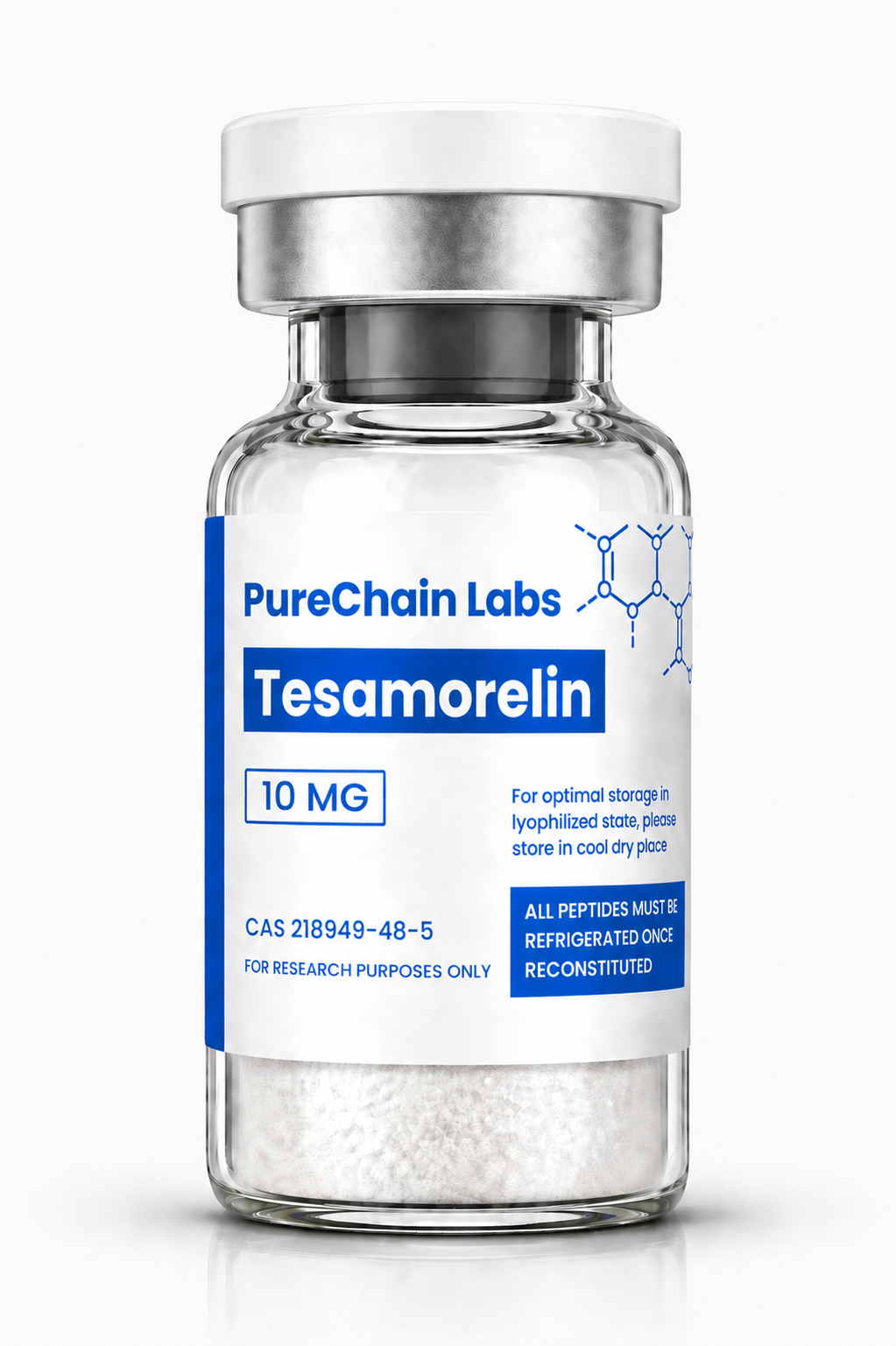
Each vial contains 10mg of highly pure Tesamorelin.
Tesamorelin is a synthetic peptide that acts as a growth hormone-releasing hormone (GHRH) analog. It is primarily used to reduce abdominal fat in HIV-infected patients with lipodystrophy, a condition characterized by abnormal fat distribution. By stimulating the release of growth hormone, tesamorelin helps improve body composition and may also have beneficial effects on metabolic parameters.
01The PureChain Standard
Purity And Documentation
Your results are only as good as the compound you start with.
Every vial is labelled with its compound, vial size and molecular weight, and ships for laboratory research use only. Third-party testing details will be published here.
Supplied for in-vitro laboratory research only. Not for human or veterinary use, and not intended to diagnose, treat, cure or prevent any disease.
- Size
- 10mg
- Form
- Lyophilized powder
- Storage
- −20 °C, protected from light
- Molar mass
- 5136 Da
About This Compound
About Tesamorelin
Tesamorelin is a synthetic analog of the full 44-residue human growth hormone-releasing hormone. Native GHRH is broken down within minutes by dipeptidyl peptidase-4; tesamorelin carries a trans-3-hexenoyl group on its N-terminus that blocks that cleavage, so the molecule survives long enough to be a usable research tool. It is studied as a receptor-level probe of the GHRH axis, the point being that it acts upstream, on the pituitary, rather than substituting for growth hormone itself.
Stabilised Growth Hormone-Releasing Hormone Analog
Molecular Formula
Molecular Weight
Form
CAS Number
02Molecular Structure
The Tesamorelin molecule
An illustrative atomic representation generated from the compound record, alongside its verified molecular data. The structure figure is schematic – not a measured conformation.
- C
- H
- N
- O
- S/P
Molecular data from the public PubChem record (CID 16137828). View on PubChem
By The Numbers
Tesamorelin Research, By The Numbers
The figures that define Tesamorelin and how it is being studied. For laboratory research use only.
Amino Acids
A full-length GHRH analog, not a truncated fragment
Receptor Target
Agonist at the pituitary growth hormone-releasing hormone receptor
Enzyme It Resists
The N-terminal hexenoyl group blocks dipeptidyl peptidase-4 cleavage
Research Areas
- GH Axis Pharmacology
- Pulsatile Secretion Models
- Visceral Adipose Research
- Peptide Stabilisation Chemistry
How It Works
How Tesamorelin Works
The pathways Tesamorelin acts on, and what each one does. Described from preclinical and receptor-pharmacology literature.
Acting On The Pituitary, Not Replacing GH
Tesamorelin binds the GHRH receptor on pituitary somatotrophs and stimulates the synthesis and release of endogenous growth hormone. Because it works through the gland, the resulting secretion stays subject to the body’s own feedback control, which is what distinguishes it from administering growth hormone directly.
- Agonist at the pituitary GHRH receptor
- Stimulates endogenous GH synthesis and release
- Downstream of the gland’s own negative feedback
Why The Hexenoyl Group Matters
Unmodified GHRH has a plasma half-life on the order of minutes because DPP-4 cleaves its first two residues. Attaching a trans-3-hexenoyl group to the N-terminus sterically blocks that step. The molecule is a standard example of stabilising a peptide by protecting its cleavage site rather than redesigning its backbone.
- N-terminal acylation blocks DPP-4 cleavage
- Substantially longer plasma survival than native GHRH
- A textbook case of peptide half-life engineering
Preserving The Natural Secretion Pattern
Growth hormone is normally released in pulses, and that pattern carries biological information. Because tesamorelin drives the pituitary rather than supplying the hormone, models using it retain a pulsatile profile, which is why it is preferred over exogenous GH in studies of secretion dynamics.
- Retains pulsatile rather than flat GH release
- IGF-1 is the downstream marker usually measured
- Used where the secretion pattern itself is the variable
Uses And Applications
What Tesamorelin Is Researched For
The main areas Tesamorelin is studied in, and the qualitative magnitudes reported alongside them.
Growth Hormone Axis Pharmacology
The core research use: characterising GHRH receptor agonism at the pituitary and the downstream GH and IGF-1 response.
Pulsatile Secretion Models
Used where the pattern of release matters, not just the amount, because pituitary-driven secretion preserves the endogenous pulse structure.
Visceral Adipose Research
Tesamorelin is the GHRH analog with the largest published literature in visceral adipose tissue models, which is the context most of its clinical research sits in.
Peptide Stabilisation Chemistry
Studied as a worked example of extending a peptide’s half-life by blocking a specific protease site, and compared against backbone-substitution approaches.
Compound Information
Full Specification
| Chemical Name | Tesamorelin (trans-3-hexenoyl-GRF(1-44) amide) |
|---|---|
| Molecular Weight | 5136 Da |
| Molecular Formula | C221H366N72O67S |
| CAS Number | 218949-48-5 |
| Form | Lyophilized powder |
| Solubility | Water-soluble |
| Storage | Store lyophilized at −20 °C, protected from light and moisture |
| Vial Size | 10mg |
| PubChem CID | 16137828 |
FAQ
Common Questions About Tesamorelin
What Is Tesamorelin?
A synthetic 44-amino-acid analog of human growth hormone-releasing hormone, modified at the N-terminus with a trans-3-hexenoyl group. It is supplied here as a research compound.
How Does It Differ From Growth Hormone Itself?
It acts one step upstream. Growth hormone is the hormone; tesamorelin is a releasing-hormone analog that stimulates the pituitary to produce its own, so the output remains under the gland’s feedback control.
What Does The Hexenoyl Group Do?
It blocks dipeptidyl peptidase-4 from cleaving the peptide’s first two residues. Native GHRH is degraded within minutes; the modification is what makes the analog usable.
How Does Tesamorelin Compare To CJC-1295 Or Sermorelin?
All three are GHRH-receptor agonists, but they differ in length and in how they resist degradation. Sermorelin and CJC-1295 are based on the 1-29 fragment; tesamorelin is the full 1-44 sequence with an N-terminal acyl group.
Is Tesamorelin Approved For Human Use?
The material supplied here is a research chemical for in-vitro laboratory use only, and is not supplied for human or veterinary use.
How Should Research-Grade Tesamorelin Be Stored?
Lyophilized tesamorelin should be stored at −20 °C, protected from light and moisture, and refrigerated once reconstituted. As a long peptide it is more sensitive to freeze-thaw cycling than the short tripeptides, so aliquot rather than repeatedly thawing one vial.
Feedback
WHAT OUR CUSTOMERS HAVE TO SAY...
"Been using PureChain Labs for 9 months now. In my opinion, it's the best source in Canada. Quality product every time and gives me the best results. Also the communication is second to none, I get a response in minutes usually. Overall extremely happy with the service and product they provide."
"A+ service and communication. Delivery is always quick and packaged safe and sound... I love how they are transparent and you know what your getting and for using a new source for the first time that's a huge relief."
"Took a month but hair felt thicker at roots, gave me hope after months of thinning, they definitely sell quality peptides."
Not for human or veterinary use. For in-vitro laboratory research only. These statements have not been evaluated by the FDA or Health Canada; this product is not intended to diagnose, treat, cure or prevent any disease.