

IGF-1 LR3 1mg
IGF-1 LR3 1mg
Couldn't load pickup availability
IGF-1 LR3 1mg
Get it as soon as -
30 Day Trial
30 Day Trial
We're confident you'll be happy with your order! In case things don't go as planned, you have 30 days to request a refund based on our return and refund policy.
Shipping & Processing
Shipping & Processing
Our shipping services are designed to be fast and reliable, ensuring your order is delivered promptly. Please allow 5-10 business days for delivery.
Track My Order
Track My Order
Once your order is shipped, we will provide you with a tracking number to monitor the progress of your shipment on our website or the shipping carrier's website. You can track your order here Track My Order
IGF-1 LR3 (Insulin-like Growth Factor 1 Long Arg3) is a synthetic form of IGF-1, a protein that plays a key role in growth, development, and cellular repair. It’s similar to the naturally occurring IGF-1 in your body but has a longer half-life due to a modification in its structure—specifically, the substitution of the amino acid arginine at position 3.
Because of this modification, IGF-1 LR3 stays in the bloodstream for a longer period of time, allowing for more extended biological effects. It’s often used in the bodybuilding and fitness community for its potential to promote muscle growth, increase fat loss, and improve recovery.
01The PureChain Standard
Purity And Documentation
Your results are only as good as the compound you start with.
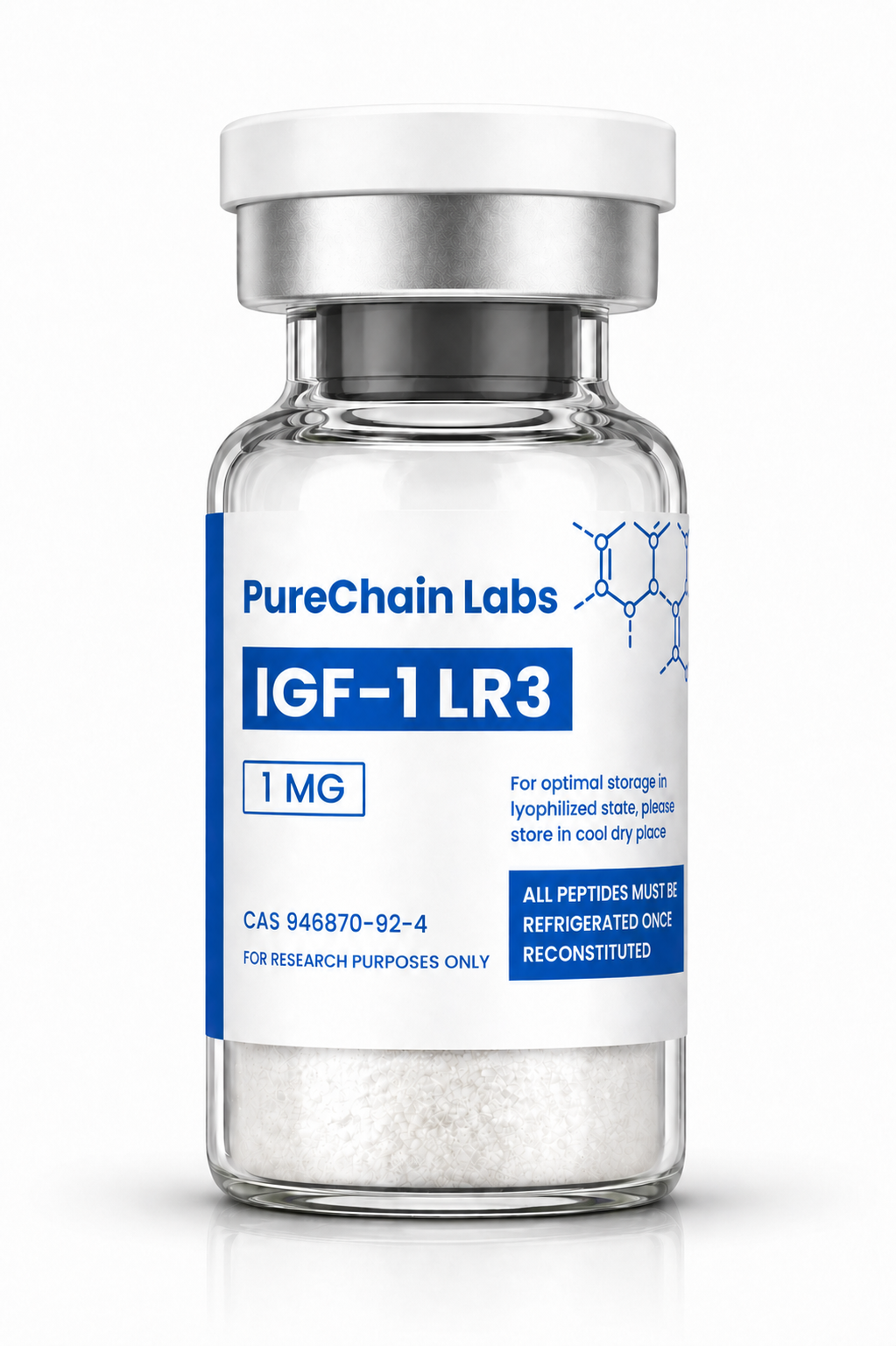
Every vial is labelled with its compound, vial size and molecular weight, and ships for laboratory research use only. Third-party testing details will be published here.
Supplied for in-vitro laboratory research only. Not for human or veterinary use, and not intended to diagnose, treat, cure or prevent any disease.
- Size
- 1mg
- Form
- Lyophilized powder
- Storage
- −20 °C, protected from light
- Molar mass
- 9117.60 Da
About This Compound
About IGF-1 LR3
IGF-1 LR3 is a laboratory-modified version of insulin-like growth factor-1 carrying two changes: an arginine substituted for glutamic acid at position three, and a 13-amino-acid extension added to the N-terminus. Both exist for one reason – to stop the molecule being captured by the IGF binding proteins. Native IGF-1 circulates almost entirely bound to those proteins, which makes free concentration hard to control in an experiment. The LR3 analog binds them far more weakly, so it is used where a predictable amount of receptor-available growth factor is needed. It has no public PubChem structural record, so the figures below come from published reference data, cited under the structure.
Modified Insulin-Like Growth Factor-1 Analog
Molecular Formula
Molecular Weight
Form
CAS Number
02Molecular Structure
The IGF-1 LR3 molecule
An illustrative atomic representation generated from the compound record, alongside its verified molecular data. The structure figure is schematic – not a measured conformation.
- C
- H
- N
- O
- S/P
No PubChem structural record exists for this compound. Molecular data from published reference data for Long R3 IGF-1. View the source
By The Numbers
IGF-1 LR3 Research, By The Numbers
The figures that define IGF-1 LR3 and how it is being studied. For laboratory research use only.
Amino Acids
The 70-residue IGF-1 sequence plus a 13-residue N-terminal extension
Key Substitution
Arginine replaces glutamic acid at position three
What The Design Avoids
Substantially reduced binding to the IGF binding proteins
Research Areas
- Growth Factor Signalling
- IGF-1 Receptor Pharmacology
- PI3K / Akt Pathway Studies
- Cell Culture Supplementation
How It Works
How IGF-1 LR3 Works
The pathways IGF-1 LR3 acts on, and what each one does. Described from preclinical and receptor-pharmacology literature.
A Receptor Tyrosine Kinase
IGF-1 LR3 binds the insulin-like growth factor-1 receptor, a receptor tyrosine kinase. Binding triggers autophosphorylation and recruits the intracellular adaptors that start the growth signalling cascades – the same receptor the native hormone acts on.
- Agonist at the IGF-1 receptor tyrosine kinase
- Triggers receptor autophosphorylation
- Also shows weak affinity at the insulin receptor
Why LR3 Exists At All
In circulation, more than 95 per cent of native IGF-1 is bound to IGF binding proteins, so its free concentration is governed by them rather than by the dose. The Arg3 substitution and the N-terminal extension both weaken that binding, which is what makes the analog useful experimentally.
- Native IGF-1 is almost entirely IGFBP-bound
- Both modifications reduce IGFBP affinity
- Gives a predictable free concentration in culture
PI3K / Akt And MAPK
Receptor activation feeds the PI3K / Akt / mTOR axis and the MAPK cascade – the two pathways behind protein synthesis, cell survival and proliferation. These are the readouts most IGF-1 LR3 experiments actually measure.
- Activates the PI3K / Akt / mTOR axis
- Also signals through the MAPK cascade
- Protein synthesis and survival are the usual endpoints
Uses And Applications
What IGF-1 LR3 Is Researched For
The main areas IGF-1 LR3 is studied in, and the qualitative magnitudes reported alongside them.
Growth Factor Signalling
The core use: studying IGF-1 receptor activation and its downstream cascades with a predictable free-ligand concentration.
Cell Culture Supplementation
Used as a culture supplement where consistent growth factor availability matters and binding protein interference would confound the result.
PI3K / Akt Pathway Studies
Applied in work on protein synthesis, cell survival and proliferation signalling downstream of the receptor.
Receptor Pharmacology
Studied alongside native IGF-1 and insulin to map selectivity across the IGF-1 and insulin receptor family.
Compound Information
Full Specification
| Chemical Name | Long R3 insulin-like growth factor-1 (IGF-1 LR3) |
|---|---|
| Molecular Weight | 9117.60 Da |
| Molecular Formula | C400H625N111O115S9 |
| CAS Number | 143045-27-6 |
| Form | Lyophilized powder |
| Solubility | Water-soluble |
| Storage | Store lyophilized at −20 °C, protected from light and moisture |
| Vial Size | 1mg |
| Structural Record | No PubChem entry; values from published reference data |
FAQ
Common Questions About IGF-1 LR3
What Is IGF-1 LR3?
A modified form of insulin-like growth factor-1 with an arginine substitution at position three and a 13-residue N-terminal extension. It is supplied here as a research compound.
What Does "LR3" Actually Mean?
"Long" refers to the 13-amino-acid N-terminal extension, and "R3" to the arginine substituted at position three. Both changes reduce binding to the IGF binding proteins.
Why Does Reduced Binding Protein Affinity Matter?
Because native IGF-1 is more than 95 per cent bound in circulation, so the binding proteins, not the dose, determine how much is free. The analog removes that variable from an experiment.
Where Do The Molecular Figures On This Page Come From?
The LR3 analog has no public PubChem structural record, so the formula and molar mass are taken from published reference data, cited under the structure. Two CAS numbers are in circulation for this material: 143045-27-6 is the primary registry, and 946870-92-4 – the one printed on the vial label – is an alternative for the same compound.
Is IGF-1 LR3 Approved For Human Use?
No. It is supplied strictly as a research chemical for in-vitro laboratory work.
How Should Research-Grade IGF-1 LR3 Be Stored?
Store the lyophilized powder at −20 °C, protected from light and moisture. As an 83-residue protein it is the most freeze-thaw sensitive item in this catalogue, so aliquot immediately after reconstitution and keep it refrigerated.
Feedback
WHAT OUR CUSTOMERS HAVE TO SAY...
"Been using PureChain Labs for 9 months now. In my opinion, it's the best source in Canada. Quality product every time and gives me the best results. Also the communication is second to none, I get a response in minutes usually. Overall extremely happy with the service and product they provide."
"A+ service and communication. Delivery is always quick and packaged safe and sound... I love how they are transparent and you know what your getting and for using a new source for the first time that's a huge relief."
"Took a month but hair felt thicker at roots, gave me hope after months of thinning, they definitely sell quality peptides."
Not for human or veterinary use. For in-vitro laboratory research only. These statements have not been evaluated by the FDA or Health Canada; this product is not intended to diagnose, treat, cure or prevent any disease.