

MOTS-C 40 MG
MOTS-C 40 MG
Couldn't load pickup availability
MOTS-C 40 MG
Get it as soon as -
30 Day Trial
30 Day Trial
We're confident you'll be happy with your order! In case things don't go as planned, you have 30 days to request a refund based on our return and refund policy.
Shipping & Processing
Shipping & Processing
Our shipping services are designed to be fast and reliable, ensuring your order is delivered promptly. Please allow 5-10 business days for delivery.
Track My Order
Track My Order
Once your order is shipped, we will provide you with a tracking number to monitor the progress of your shipment on our website or the shipping carrier's website. You can track your order here Track My Order
Each vial contains 40mg of highly pure MOTS-C.
MOTS-c (Mitochondrial Open Reading Frame of the 12S rRNA Type-c) is a mitochondrial-derived peptide consisting of 16 amino acids. It plays a key role in cellular metabolism and energy homeostasis, acting through pathways related to insulin sensitivity, glucose metabolism, and stress response.
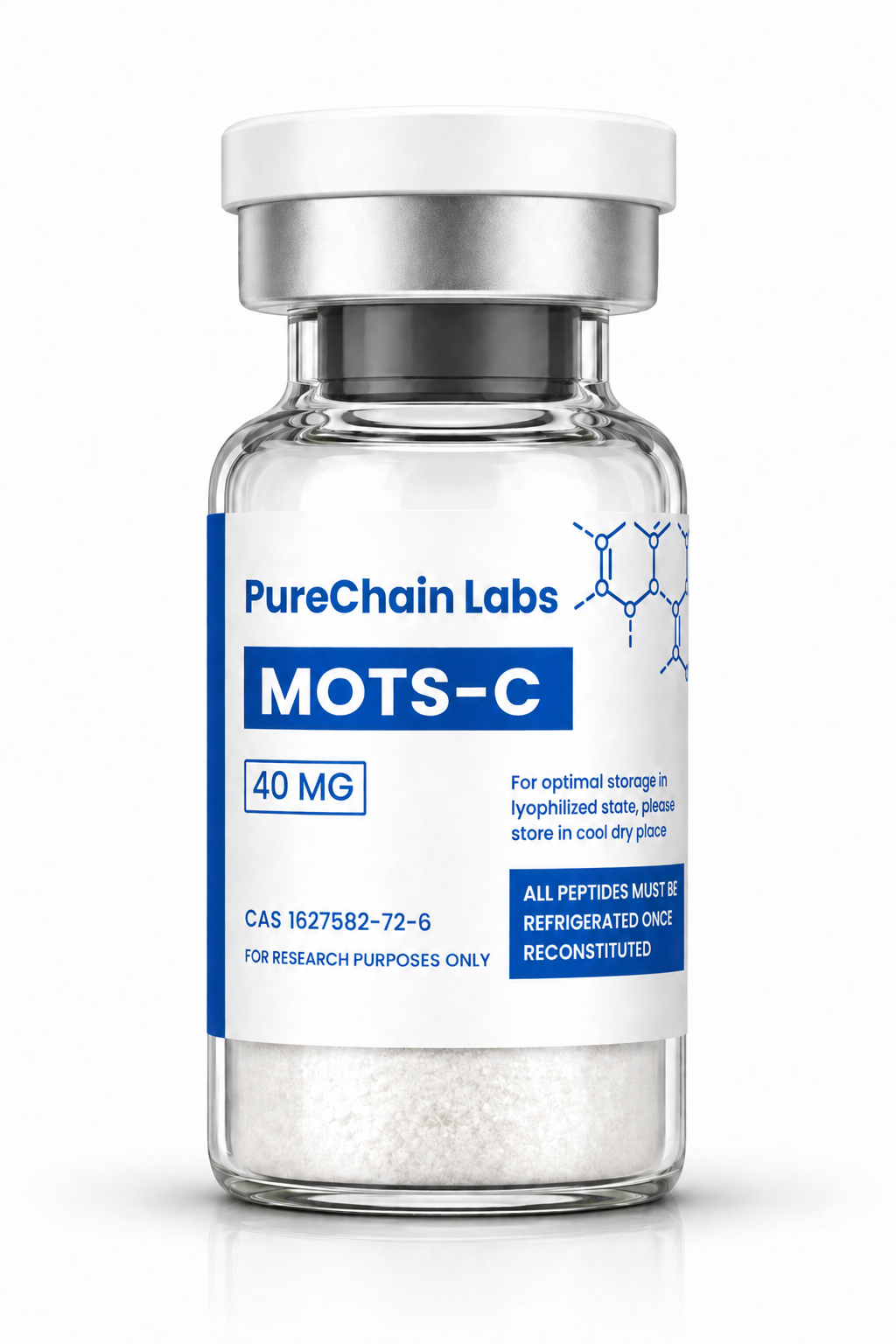
01The PureChain Standard
Purity And Documentation
Your results are only as good as the compound you start with.
Every vial is labelled with its compound, vial size and molecular weight, and ships for laboratory research use only. Third-party testing details will be published here.
Supplied for in-vitro laboratory research only. Not for human or veterinary use, and not intended to diagnose, treat, cure or prevent any disease.
- Size
- 40mg
- Form
- Lyophilized powder
- Storage
- −20 °C, protected from light
- Molar mass
- 2174.6 Da
About This Compound
About MOTS-c
MOTS-c is a 16-residue peptide encoded not in the cell nucleus but in the mitochondrial genome, within the 12S ribosomal RNA gene. That origin is the reason it is studied: it is evidence that mitochondria send signals outward rather than only receiving them, and it belongs to a small class of mitochondrial-derived peptides discovered in the last two decades. Research centres on AMPK activation and the folate–methionine cycle, and on the observation that the peptide translocates to the nucleus under metabolic stress.
Mitochondrial-Derived Peptide
Molecular Formula
Molecular Weight
Form
CAS Number
02Molecular Structure
The MOTS-c molecule
An illustrative atomic representation generated from the compound record, alongside its verified molecular data. The structure figure is schematic – not a measured conformation.
- C
- H
- N
- O
- S/P
Molecular data from the public PubChem record (CID 146675088). View on PubChem
By The Numbers
MOTS-c Research, By The Numbers
The figures that define MOTS-c and how it is being studied. For laboratory research use only.
Amino Acids
Encoded within the mitochondrial 12S rRNA gene, not the nuclear genome
Year First Described
Reported as a mitochondrial-derived peptide regulating metabolism
Primary Pathway
Studied for activation of AMP-activated protein kinase
Research Areas
- Mitochondrial Signalling
- AMPK Pathway Studies
- Insulin-Sensitivity Models
- Mitonuclear Communication
How It Works
How MOTS-c Works
The pathways MOTS-c acts on, and what each one does. Described from preclinical and receptor-pharmacology literature.
The Cellular Energy Sensor
AMP-activated protein kinase is the switch cells throw when energy runs short, shifting them from building molecules to burning them. Published work reports that MOTS-c activates this pathway, which is the most cited mechanism in the literature and the reason the peptide appears in metabolic research.
- Reported activation of the AMPK pathway
- Shifts cells towards catabolic metabolism in models
- The pathway targeted by several established metabolic agents
Methionine And Purine Metabolism
The reported route to AMPK activation runs through the folate–methionine cycle and the accumulation of AICAR, an endogenous AMPK activator. This makes MOTS-c a study in indirect pathway activation rather than direct kinase binding.
- Acts on the folate and methionine cycle
- AICAR accumulation as the intermediate step
- Indirect rather than direct kinase engagement
A Signal That Travels To The Nucleus
Under metabolic stress MOTS-c has been reported to translocate to the nucleus and associate with stress-responsive transcription factors. That makes it a direct example of mitochondria influencing nuclear gene expression, which is the broader reason the peptide class is studied.
- Reported nuclear translocation under metabolic stress
- Associates with stress-responsive transcription factors
- Evidence for mitochondria-to-nucleus signalling
Uses And Applications
What MOTS-c Is Researched For
The main areas MOTS-c is studied in, and the qualitative magnitudes reported alongside them.
Mitochondrial Signalling Research
The defining use. MOTS-c is a reference compound for the mitochondrial-derived peptide class and for the idea that mitochondria encode their own signalling molecules.
AMPK Pathway Studies
Used in cell and tissue models investigating AMPK activation and the metabolic switch from anabolic to catabolic states.
Insulin-Sensitivity Models
Applied in preclinical metabolic work examining glucose handling and insulin sensitivity in muscle and adipose tissue models.
Mitonuclear Communication
Studied specifically for its reported nuclear translocation, as a tractable example of a mitochondrial signal reaching nuclear transcription.
Compound Information
Full Specification
| Chemical Name | MOTS-c (mitochondrial ORF of the 12S rRNA type-c) |
|---|---|
| Sequence | Met-Arg-Trp-Gln-Glu-Met-Gly-Tyr-Ile-Phe-Tyr-Pro-Arg-Lys-Leu-Arg |
| Molecular Weight | 2174.6 Da |
| Molecular Formula | C101H152N28O22S2 |
| CAS Number | 1627580-64-6 |
| Form | Lyophilized powder |
| Solubility | Water-soluble |
| Storage | Store lyophilized at −20 °C, protected from light and moisture |
| Vial Size | 40mg |
| PubChem CID | 146675088 |
FAQ
Common Questions About MOTS-c
What Is MOTS-c?
A 16-amino-acid peptide encoded inside the mitochondrial genome, in the 12S ribosomal RNA gene. It is supplied here as a research compound.
Why Does It Matter That It Is Mitochondrially Encoded?
Because almost every protein in a cell is encoded in the nucleus. A peptide encoded by the mitochondrial genome that then acts on the rest of the cell is direct evidence of mitochondria-to-nucleus signalling.
What Is AMPK?
AMP-activated protein kinase, the enzyme that senses low cellular energy and switches metabolism from building to burning. It is the pathway most often measured in MOTS-c research.
Is MOTS-c Related To Humanin?
Yes, in class. Humanin was the first mitochondrial-derived peptide described; MOTS-c is a later member of the same small family and the two are often discussed together.
Is MOTS-c Approved For Human Use?
No. It is supplied as a research chemical for in-vitro laboratory work only, not for human or veterinary use.
How Should Research-Grade MOTS-c Be Stored?
Store the lyophilized powder at −20 °C, protected from light and moisture, and refrigerate once reconstituted. The two methionine residues are oxidation-prone, so avoid repeated freeze-thaw cycles.
Feedback
WHAT OUR CUSTOMERS HAVE TO SAY...
"Been using PureChain Labs for 9 months now. In my opinion, it's the best source in Canada. Quality product every time and gives me the best results. Also the communication is second to none, I get a response in minutes usually. Overall extremely happy with the service and product they provide."
"A+ service and communication. Delivery is always quick and packaged safe and sound... I love how they are transparent and you know what your getting and for using a new source for the first time that's a huge relief."
"Took a month but hair felt thicker at roots, gave me hope after months of thinning, they definitely sell quality peptides."
Not for human or veterinary use. For in-vitro laboratory research only. These statements have not been evaluated by the FDA or Health Canada; this product is not intended to diagnose, treat, cure or prevent any disease.