

NAD+
NAD+
Couldn't load pickup availability
NAD+
Get it as soon as -
30 Day Trial
30 Day Trial
We're confident you'll be happy with your order! In case things don't go as planned, you have 30 days to request a refund based on our return and refund policy.
Shipping & Processing
Shipping & Processing
Our shipping services are designed to be fast and reliable, ensuring your order is delivered promptly. Please allow 5-10 business days for delivery.
Track My Order
Track My Order
Once your order is shipped, we will provide you with a tracking number to monitor the progress of your shipment on our website or the shipping carrier's website. You can track your order here Track My Order
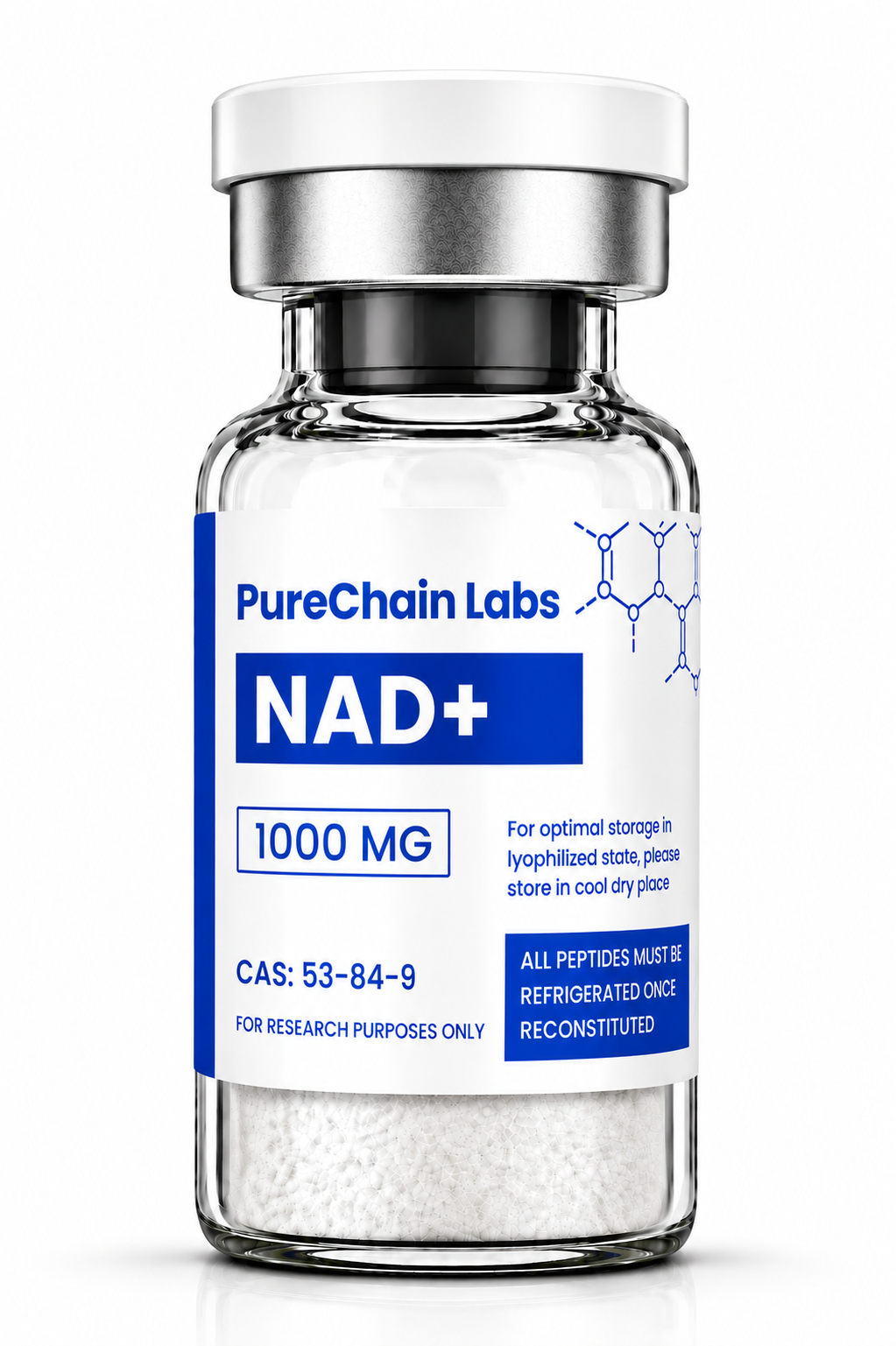
Each 10mL vial contains 1000mg of lyophilized NAD+.
Overview:
High-purity NAD+ (Nicotinamide Adenine Dinucleotide) solution used in research on cellular energy, mitochondrial function, metabolic pathways, and stress responses.
Potential Benefits (Research Context Only):
Studies suggest NAD+ may:
-
Support cellular energy production (ATP generation)
-
Influence mitochondrial health and biogenesis
-
Play a role in DNA repair pathways
-
Affect cellular aging mechanisms (sirtuin activity)
-
Modulate oxidative stress responses
01The PureChain Standard
Purity And Documentation
Your results are only as good as the compound you start with.
Every vial is labelled with its compound, vial size and molecular weight, and ships for laboratory research use only. Third-party testing details will be published here.
Supplied for in-vitro laboratory research only. Not for human or veterinary use, and not intended to diagnose, treat, cure or prevent any disease.
- Size
- 1000mg
- Form
- Lyophilized powder
- Storage
- −20 °C, protected from light
- Molar mass
- 663.4 Da
About This Compound
About NAD+
NAD+ is not a peptide. It is a dinucleotide coenzyme built from nicotinamide mononucleotide and adenosine monophosphate, and it is present in every living cell. Its function is to carry electrons: the nicotinamide ring accepts a hydride to become NADH and gives it back to become NAD+ again, which is the redox couple that glycolysis, the citric acid cycle and oxidative phosphorylation are all built on. Beyond that metabolic role it is also consumed as a substrate by the sirtuins and the PARP enzymes, which is what put it at the centre of cellular-ageing research.
Pyridine Dinucleotide Coenzyme
Molecular Formula
Molecular Weight
Form
CAS Number
02Molecular Structure
The NAD+ molecule
An illustrative atomic representation generated from the compound record, alongside its verified molecular data. The structure figure is schematic – not a measured conformation.
- C
- H
- N
- O
- S/P
Molecular data from the public PubChem record (CID 5892). View on PubChem
By The Numbers
NAD+ Research, By The Numbers
The figures that define NAD+ and how it is being studied. For laboratory research use only.
Nucleotides
Nicotinamide mononucleotide joined to adenosine monophosphate
Year First Described
Identified in yeast extract by Harden and Young as a "cozymase"
Distinct Roles
A redox electron carrier, and a consumed substrate for sirtuins and PARPs
Research Areas
- Cellular Energy Metabolism
- Sirtuin Signalling
- DNA Repair And PARP Activity
- Mitochondrial Function
How It Works
How NAD+ Works
The pathways NAD+ acts on, and what each one does. Described from preclinical and receptor-pharmacology literature.
The Cell’s Electron Carrier
The nicotinamide ring accepts a hydride ion to form NADH and releases it to return to NAD+. That single reversible step is how reducing equivalents move from glycolysis and the citric acid cycle to the electron transport chain, which is where the majority of cellular ATP is generated.
- NAD+ / NADH is the central redox couple of metabolism
- Feeds electrons into oxidative phosphorylation
- The ratio between the two forms is itself a measured variable
Consumed, Not Just Recycled
The sirtuin deacetylases require NAD+ as a co-substrate and destroy a molecule of it with every reaction, releasing nicotinamide. This makes cellular NAD+ availability a rate-limiting input to sirtuin activity, and it is the mechanistic basis of most NAD+ research in ageing biology.
- Sirtuins consume NAD+ stoichiometrically
- Links metabolic state to protein deacetylation
- Availability, not enzyme level, is often the limiting factor
DNA Damage Response
Poly(ADP-ribose) polymerases also consume NAD+, using it to build ADP-ribose chains as part of the DNA damage response. Heavy PARP activation therefore draws down the cellular NAD+ pool, which connects genomic stress directly to energy metabolism.
- PARPs use NAD+ to build ADP-ribose polymers
- DNA damage depletes the cellular NAD+ pool
- Couples genome maintenance to metabolic state
Uses And Applications
What NAD+ Is Researched For
The main areas NAD+ is studied in, and the qualitative magnitudes reported alongside them.
Cellular Energy Metabolism
The foundational use. NAD+ is a required reagent and a measured variable in essentially any assay touching glycolysis, the citric acid cycle or oxidative phosphorylation.
Sirtuin Signalling Research
Used to study the NAD+-dependent deacetylases and how substrate availability gates their activity in cell and tissue models.
DNA Repair And PARP Studies
Applied in work on the DNA damage response, where PARP consumption of NAD+ links genomic stress to the cell’s energy budget.
Mitochondrial Function
A standard input in mitochondrial research, including studies of the age-associated decline in tissue NAD+ levels and its relationship to mitochondrial output.
Compound Information
Full Specification
| Chemical Name | Nicotinamide adenine dinucleotide (oxidised form) |
|---|---|
| Molecular Weight | 663.4 Da |
| Molecular Formula | C21H27N7O14P2 |
| CAS Number | 53-84-9 |
| Form | Lyophilized powder |
| Solubility | Water-soluble |
| Storage | Store lyophilized at −20 °C, protected from light and moisture |
| Vial Size | 1000mg |
| PubChem CID | 5892 |
FAQ
Common Questions About NAD+
What Is NAD+?
Nicotinamide adenine dinucleotide in its oxidised form: a coenzyme found in every living cell, built from nicotinamide mononucleotide joined to adenosine monophosphate.
Is NAD+ A Peptide?
No. Unlike almost everything else in this catalogue, NAD+ is a small-molecule dinucleotide, not a chain of amino acids. It is handled and stored differently for that reason.
What Is The Difference Between NAD+ And NADH?
They are the two halves of one redox couple. NAD+ is the oxidised form that accepts a hydride ion; NADH is the reduced form that carries it. Cells cycle between them continuously.
How Is NAD+ Related To NMN And Nicotinamide Riboside?
NMN and NR are precursors. Cells convert them into NAD+ through the salvage pathway, which is why they appear together in the same body of research.
Why Is NAD+ Studied In Ageing Research?
Because tissue NAD+ levels fall with age in published models, and because the sirtuins and PARPs consume it as a substrate. That combination makes its availability a plausible limiting factor, which is what the research investigates.
How Should Research-Grade NAD+ Be Stored?
Store the lyophilized powder at −20 °C, protected from light and moisture. NAD+ is hygroscopic and unstable in solution, particularly at alkaline pH, so prepare solutions fresh and keep them cold.
Feedback
WHAT OUR CUSTOMERS HAVE TO SAY...
"Been using PureChain Labs for 9 months now. In my opinion, it's the best source in Canada. Quality product every time and gives me the best results. Also the communication is second to none, I get a response in minutes usually. Overall extremely happy with the service and product they provide."
"A+ service and communication. Delivery is always quick and packaged safe and sound... I love how they are transparent and you know what your getting and for using a new source for the first time that's a huge relief."
"Took a month but hair felt thicker at roots, gave me hope after months of thinning, they definitely sell quality peptides."
Not for human or veterinary use. For in-vitro laboratory research only. These statements have not been evaluated by the FDA or Health Canada; this product is not intended to diagnose, treat, cure or prevent any disease.