

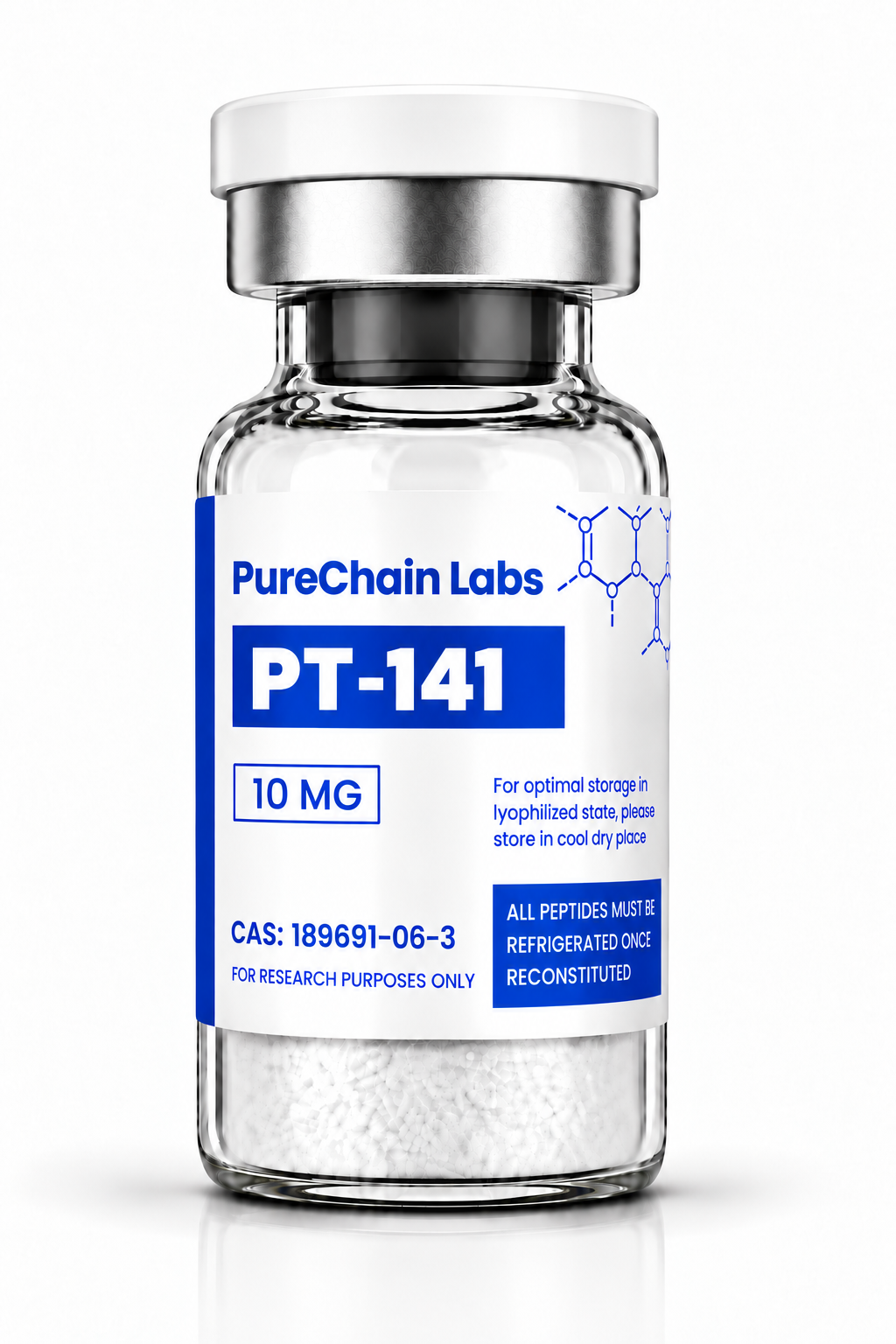
PT-141 10mg
PT-141 10mg
Couldn't load pickup availability
PT-141 10mg
Get it as soon as -
30 Day Trial
30 Day Trial
We're confident you'll be happy with your order! In case things don't go as planned, you have 30 days to request a refund based on our return and refund policy.
Shipping & Processing
Shipping & Processing
Our shipping services are designed to be fast and reliable, ensuring your order is delivered promptly. Please allow 5-10 business days for delivery.
Track My Order
Track My Order
Once your order is shipped, we will provide you with a tracking number to monitor the progress of your shipment on our website or the shipping carrier's website. You can track your order here Track My Order
PT-141 (Bremelanotide) is a peptide used to treat sexual dysfunction. FDA-approved as Vyleesi, it treats hypoactive sexual desire disorder (HSDD) in women and is also studied for erectile dysfunction (ED). Unlike Viagra, it works by stimulating the melanocortin system in the brain to enhance arousal. Administered via injection, effects start within 30-60 minutes and last 6-12 hours. Side effects include nausea, flushing, headaches, and increased blood pressure.
01The PureChain Standard
Purity And Documentation
Your results are only as good as the compound you start with.
Every vial is labelled with its compound, vial size and molecular weight, and ships for laboratory research use only. Third-party testing details will be published here.
Supplied for in-vitro laboratory research only. Not for human or veterinary use, and not intended to diagnose, treat, cure or prevent any disease.
- Size
- 10mg
- Form
- Lyophilized powder
- Storage
- −20 °C, protected from light
- Molar mass
- 1025.2 Da
About This Compound
About PT-141
PT-141, also known as bremelanotide, is a synthetic cyclic heptapeptide derived directly from Melanotan II. Where Melanotan II ends in an amide, PT-141 carries a free carboxylic acid at the same position, and that single change shifts the molecule away from the pigmentation receptor and towards the central melanocortin receptors. It is used in research as a comparatively selective melanocortin probe, and it is the compound that established that melanocortin signalling in the brain, rather than the vascular system, sits behind a distinct arousal pathway.
Cyclic Heptapeptide Melanocortin Receptor Agonist
Molecular Formula
Molecular Weight
Form
CAS Number
02Molecular Structure
The PT-141 molecule
An illustrative atomic representation generated from the compound record, alongside its verified molecular data. The structure figure is schematic – not a measured conformation.
- C
- H
- N
- O
- S/P
Molecular data from the public PubChem record (CID 9941379). View on PubChem
By The Numbers
PT-141 Research, By The Numbers
The figures that define PT-141 and how it is being studied. For laboratory research use only.
Amino Acids
Cyclic heptapeptide, the des-amide metabolite of Melanotan II
Primary Receptor Target
Acts mainly at the central melanocortin-4 receptor
Period First Described
Identified during melanocortin work that followed Melanotan II
Research Areas
- Central Arousal Pathways
- Melanocortin Receptor Pharmacology
- Neuroendocrine Signalling
- Structure-Activity Research
How It Works
How PT-141 Works
The pathways PT-141 acts on, and what each one does. Described from preclinical and receptor-pharmacology literature.
Central Melanocortin-4 Signalling
PT-141 activates MC4R, a G protein-coupled receptor concentrated in the hypothalamus and other central nervous system regions. Activation raises intracellular cAMP in those neurons, which is the signalling step researchers measure when mapping melanocortin circuitry.
- Agonist at the melanocortin-4 receptor
- Signals through adenylyl cyclase and cAMP
- Central rather than peripheral site of action
A Non-Vascular Arousal Pathway
The research interest in PT-141 comes from where it does not act. Unlike PDE5-targeting compounds, it does not work on vascular smooth muscle, so preclinical studies using it separate centrally-mediated arousal signalling from blood-flow mechanisms.
- Does not act on the nitric oxide / cGMP vascular pathway
- Used to isolate central from peripheral mechanisms
- Studied in models where vascular agents show no effect
Selectivity Against Melanotan II
Melanotan II activates MC1R through MC5R broadly. PT-141 retains potency at MC3R and MC4R while binding MC1R far more weakly, which is why the two compounds are routinely compared side by side in structure-activity work.
- Markedly reduced MC1R activity versus Melanotan II
- Retains MC3R and MC4R agonism
- The C-terminal acid, not the peptide ring, drives the shift
Uses And Applications
What PT-141 Is Researched For
The main areas PT-141 is studied in, and the qualitative magnitudes reported alongside them.
Central Arousal Pathway Models
The primary research use. PT-141 is the standard tool compound for probing melanocortin-mediated arousal circuitry in preclinical models, because its central site of action separates that pathway from vascular mechanisms.
Melanocortin Receptor Pharmacology
Used in binding and functional assays across the MC1R to MC5R family to characterise what selectivity a C-terminal modification buys, and what it costs.
Structure-Activity Research
PT-141 and Melanotan II differ by one terminal group, which makes the pair a clean case study in how a minimal change redirects a peptide across a receptor family.
Neuroendocrine Signalling
Applied in work on hypothalamic signalling, where MC4R sits in circuits involving feeding behaviour, energy balance and autonomic output.
Compound Information
Full Specification
| Chemical Name | Bremelanotide (PT-141) |
|---|---|
| Sequence | Ac-Nle-cyclo[Asp-His-D-Phe-Arg-Trp-Lys]-OH |
| Molecular Weight | 1025.2 Da |
| Molecular Formula | C50H68N14O10 |
| CAS Number | 189691-06-3 |
| Form | Lyophilized powder |
| Solubility | Water-soluble |
| Storage | Store lyophilized at −20 °C, protected from light and moisture |
| Vial Size | 10mg |
| PubChem CID | 9941379 |
FAQ
Common Questions About PT-141
What Is PT-141?
PT-141, or bremelanotide, is a synthetic cyclic heptapeptide and a melanocortin receptor agonist. It is a chemical derivative of Melanotan II and is supplied here strictly as a research compound.
How Does PT-141 Differ From Melanotan II?
Chemically, by one group: Melanotan II ends in a C-terminal amide and PT-141 in a free acid. Pharmacologically that shifts it away from MC1R, the pigmentation receptor, while it keeps its activity at the central MC3R and MC4R receptors.
Why Is PT-141 Studied Separately From Vascular Compounds?
Because it acts centrally. PDE5-targeting compounds work on the nitric oxide and cGMP pathway in vascular smooth muscle; PT-141 does not, so preclinical work with it isolates a nervous-system pathway rather than a blood-flow one.
Is PT-141 Approved For Human Use?
Nothing supplied by PureChain Labs is approved for human use or sold for it. This material is supplied as a research chemical for in-vitro laboratory work only, and the regulatory status of any bremelanotide product elsewhere has no bearing on that.
What Is The Melanocortin System?
A family of five G protein-coupled receptors, MC1R through MC5R, that respond to endogenous ligands including alpha-MSH. Between them they sit behind pigmentation, energy balance, inflammation and arousal signalling.
How Should Research-Grade PT-141 Be Stored?
Lyophilized PT-141 should be kept at −20 °C, protected from light and moisture, and refrigerated once reconstituted. The cyclic backbone is relatively robust, but the powder should still be stored cold and dry until it is used.
Feedback
WHAT OUR CUSTOMERS HAVE TO SAY...
"Been using PureChain Labs for 9 months now. In my opinion, it's the best source in Canada. Quality product every time and gives me the best results. Also the communication is second to none, I get a response in minutes usually. Overall extremely happy with the service and product they provide."
"A+ service and communication. Delivery is always quick and packaged safe and sound... I love how they are transparent and you know what your getting and for using a new source for the first time that's a huge relief."
"Took a month but hair felt thicker at roots, gave me hope after months of thinning, they definitely sell quality peptides."
Not for human or veterinary use. For in-vitro laboratory research only. These statements have not been evaluated by the FDA or Health Canada; this product is not intended to diagnose, treat, cure or prevent any disease.