

BPC-157 / TB-500 “Healing Blend”
BPC-157 / TB-500 “Healing Blend”
Couldn't load pickup availability
BPC-157 / TB-500 “Healing Blend”
Get it as soon as -
30 Day Trial
30 Day Trial
We're confident you'll be happy with your order! In case things don't go as planned, you have 30 days to request a refund based on our return and refund policy.
Shipping & Processing
Shipping & Processing
Our shipping services are designed to be fast and reliable, ensuring your order is delivered promptly. Please allow 5-10 business days for delivery.
Track My Order
Track My Order
Once your order is shipped, we will provide you with a tracking number to monitor the progress of your shipment on our website or the shipping carrier's website. You can track your order here Track My Order
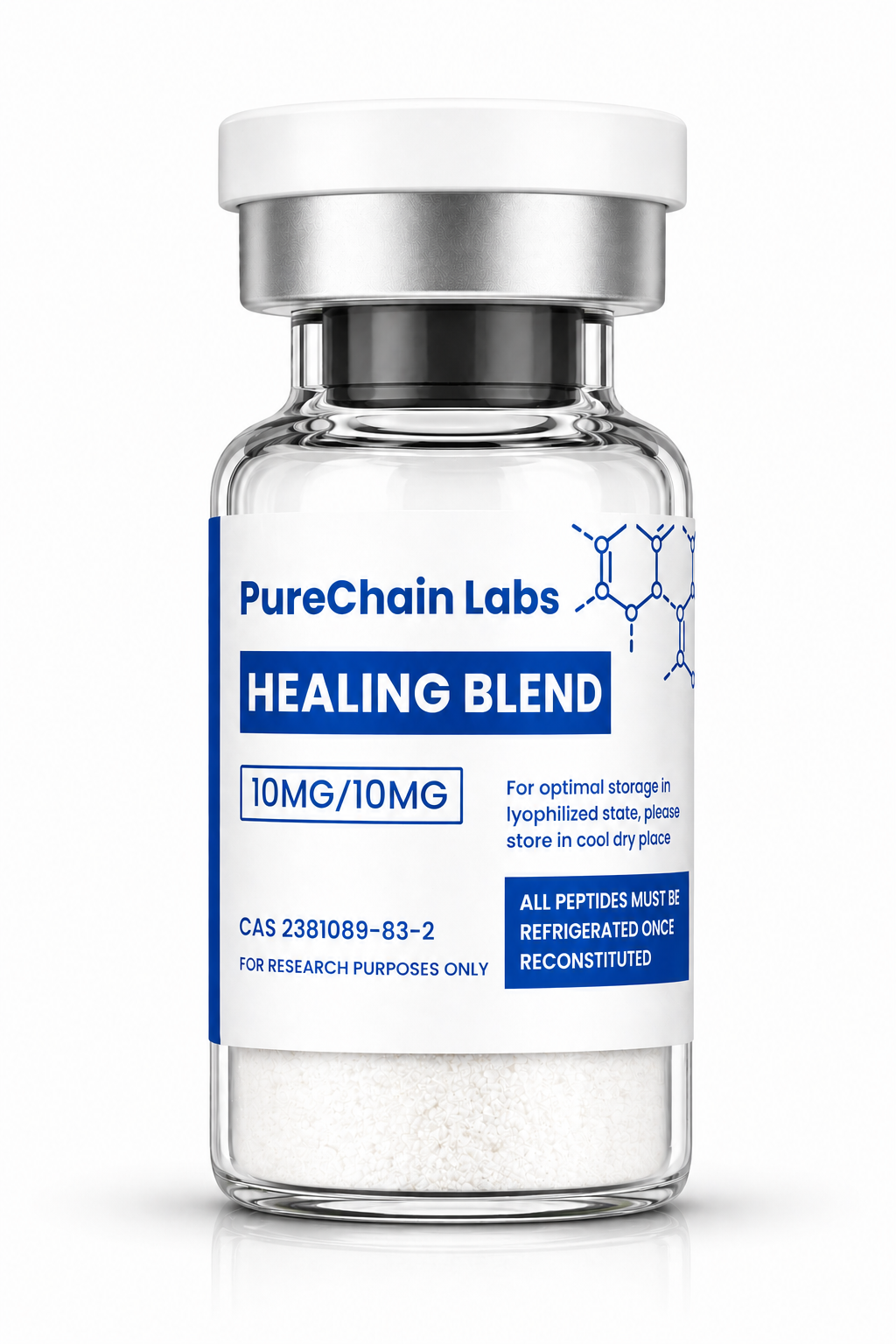
Each vial contains 10mg of BPC-157 and 10mg of TB-500.
Our “Healing Blend” combines BPC-157 and TB-500 (TB-4) at an ideal 1:1 ratio that takes advantage of their synergistic healing effects when used in conjunction.
BPC-157, short for Body Protection Compound 157, is a chain of fifteen amino acids with various mechanisms of action, including activating cells involved in tissue repair, including muscles, tendons, ligaments and the gastrointestinal tract, stimulating the synthesis of growth factors, and inhibiting inflammation.
TB-500 (TB-4, short for Thymosin β4) is a naturally-occurring peptide that plays a vital role in the repair and regeneration of injured cells and tissues by promoting cell migration, forming new blood vessels and regenerating the tissue as well as decreasing the number of myofibroblasts in wounds, resulting in decreased scar formation and fibrosis.
01The PureChain Standard
Purity And Documentation
Your results are only as good as the compound you start with.
Every vial is labelled with its compound, vial size and molecular weight, and ships for laboratory research use only. Third-party testing details will be published here.
Supplied for in-vitro laboratory research only. Not for human or veterinary use, and not intended to diagnose, treat, cure or prevent any disease.
- Size
- 10mg / 10mg
- Form
- Lyophilized powder
- Storage
- −20 °C, protected from light
- Components
- BPC-157 10mg · TB-500 10mg
About This Compound
About BPC-157 / TB-500 Blend
This is a two-component blend, not a single compound: 10mg of BPC-157 and 10mg of TB-500 in one vial. The two are combined in research because they act through different mechanisms. BPC-157 is a 15-residue sequence derived from a protein found in human gastric juice, studied largely for angiogenic signalling and VEGF receptor pathways. TB-500 is a fragment of thymosin beta-4 whose defining property is binding G-actin, the monomer form of the cytoskeletal protein. Because the vial contains two molecules, no single molecular weight, formula or CAS applies to it; the chemistry for each component is published on its own page.
Two-Component Peptide Blend · BPC-157 + TB-500
Form
Vial Size
02Molecular Structure · Component 1 Of 2
The BPC-157 molecule
An illustrative atomic representation generated from the compound record, alongside its verified molecular data. The structure figure is schematic – not a measured conformation.
- C
- H
- N
- O
- S/P
Molecular data from the public PubChem record (CID 9941957). View on PubChem
03Molecular Structure · Component 2 Of 2
The TB-500 molecule
An illustrative atomic representation generated from the compound record, alongside its verified molecular data. The structure figure is schematic – not a measured conformation.
- C
- H
- N
- O
- S/P
Molecular data from the public PubChem record (CID 62707662). View on PubChem
By The Numbers
BPC-157 / TB-500 Blend Research, By The Numbers
The figures that define BPC-157 / TB-500 Blend and how it is being studied. For laboratory research use only.
Components
BPC-157 and TB-500, 10mg of each in one vial
Residues In BPC-157
A pentadecapeptide derived from a human gastric juice protein
TB-500 Binding Target
The monomeric form of the cytoskeletal protein actin
Research Areas
- Angiogenesis Models
- Cytoskeletal Dynamics
- Tissue Repair Research
- Multi-Pathway Blend Studies
How It Works
How BPC-157 / TB-500 Blend Works
The pathways BPC-157 / TB-500 Blend acts on, and what each one does. Described from preclinical and receptor-pharmacology literature.
Angiogenic And VEGF Signalling
BPC-157 is a 15-amino-acid sequence taken from body protection compound, a protein isolated from human gastric juice. Published preclinical work concentrates on angiogenic signalling, including the VEGFR2 pathway and nitric oxide signalling, in tissue repair models.
- A 15-residue gastric juice protein fragment
- Studied for VEGFR2 and angiogenic signalling
- Nitric oxide pathway involvement reported
Actin Sequestration
TB-500 corresponds to the active region of thymosin beta-4, whose central property is binding G-actin. By sequestering actin monomers it influences the balance between monomeric and filamentous actin, which is what governs cell motility and cytoskeletal remodelling.
- Binds G-actin, the monomeric form
- Shifts the G-actin to F-actin balance
- Cell migration is the usual measured endpoint
Two Mechanisms, One Model
The research rationale for combining them is that they do different things: one is studied for blood vessel formation, the other for cytoskeletal reorganisation and cell migration. Blend studies ask whether the two pathways are additive in the same model.
- Distinct and non-overlapping mechanisms
- Angiogenesis paired with cell migration
- Blends are studied for additivity, not potency
Uses And Applications
What BPC-157 / TB-500 Blend Is Researched For
The main areas BPC-157 / TB-500 Blend is studied in, and the qualitative magnitudes reported alongside them.
Angiogenesis Models
Driven by the BPC-157 component, in preclinical work on new blood vessel formation and VEGF pathway signalling.
Cytoskeletal Dynamics
Driven by the TB-500 component, in studies of actin polymerisation and cell migration.
Tissue Repair Research
The context most blend work sits in, where both angiogenesis and cell migration are measured endpoints in the same model.
Multi-Pathway Blend Studies
Used to investigate whether two compounds acting on separate pathways produce additive effects when applied together.
Compound Information
Full Specification
| Chemical Name | BPC-157 and TB-500 (two-component blend) |
|---|---|
| Form | Lyophilized powder |
| Solubility | Both components water-soluble |
| Storage | Store lyophilized at −20 °C, protected from light and moisture |
| Vial Size | 10mg / 10mg |
FAQ
Common Questions About BPC-157 / TB-500 Blend
What Is In This Vial?
Two separate peptides: 10mg of BPC-157 and 10mg of TB-500. It is a blend, not a single compound.
Why Is There No Molecular Weight Or CAS On This Page?
Because those values describe one molecule, and this vial contains two. The chemistry for each component is published on that component’s own page.
What Is BPC-157?
A 15-amino-acid sequence derived from body protection compound, a protein isolated from human gastric juice. Preclinical research on it concentrates on angiogenic signalling.
What Is TB-500?
A fragment corresponding to the active region of thymosin beta-4. Its defining property is binding G-actin, the monomeric form of the cytoskeletal protein actin.
Why Are They Combined?
Because the mechanisms do not overlap. One is studied for blood vessel formation and the other for cytoskeletal remodelling and cell migration, so combining them lets both be examined in one model.
How Should This Blend Be Stored?
Store the lyophilized powder at −20 °C, protected from light and moisture, and refrigerate once reconstituted. Both components are peptides and both are freeze-thaw sensitive.
Feedback
WHAT OUR CUSTOMERS HAVE TO SAY...
"Been using PureChain Labs for 9 months now. In my opinion, it's the best source in Canada. Quality product every time and gives me the best results. Also the communication is second to none, I get a response in minutes usually. Overall extremely happy with the service and product they provide."
"A+ service and communication. Delivery is always quick and packaged safe and sound... I love how they are transparent and you know what your getting and for using a new source for the first time that's a huge relief."
"Took a month but hair felt thicker at roots, gave me hope after months of thinning, they definitely sell quality peptides."
Not for human or veterinary use. For in-vitro laboratory research only. These statements have not been evaluated by the FDA or Health Canada; this product is not intended to diagnose, treat, cure or prevent any disease.