


GHK-Cu
GHK-Cu
Couldn't load pickup availability
GHK-Cu
Get it as soon as -
30 Day Trial
30 Day Trial
We're confident you'll be happy with your order! In case things don't go as planned, you have 30 days to request a refund based on our return and refund policy.
Shipping & Processing
Shipping & Processing
Our shipping services are designed to be fast and reliable, ensuring your order is delivered promptly. Please allow 5-10 business days for delivery.
Track My Order
Track My Order
Once your order is shipped, we will provide you with a tracking number to monitor the progress of your shipment on our website or the shipping carrier's website. You can track your order here Track My Order
GHK-Cu Copper Peptide – Skin Regeneration & Anti-Aging Powerhouse
Rediscover youthful skin with GHK-Cu (Copper Tripeptide-1), a naturally occurring peptide renowned for its regenerative and anti-aging properties. This potent compound combines the tripeptide GHK (glycyl-L-histidyl-L-lysine) with a copper ion, creating a biologically active molecule that supports skin health, hair growth, and tissue repair.
Key Benefits:
- Stimulates Collagen & Elastin Production: Helps reduce fine lines, wrinkles, and improve skin elasticity.
- Accelerates Wound Healing: Enhances tissue repair and regeneration for faster recovery.
- Anti-Inflammatory & Antioxidant: Reduces redness, irritation, and oxidative stress on the skin.
- Improves Skin Texture & Firmness: Promotes a smoother, more youthful complexion.
- Supports Hair Growth: Often used in hair care to revitalize dormant follicles and reduce hair thinning.
Ideal For:
- Anti-aging skincare routines
- Post-procedure skin recovery
- Hair loss and thinning hair treatments
- Skin firmness and elasticity improvement

01The PureChain Standard
Purity And Documentation
Your results are only as good as the compound you start with.
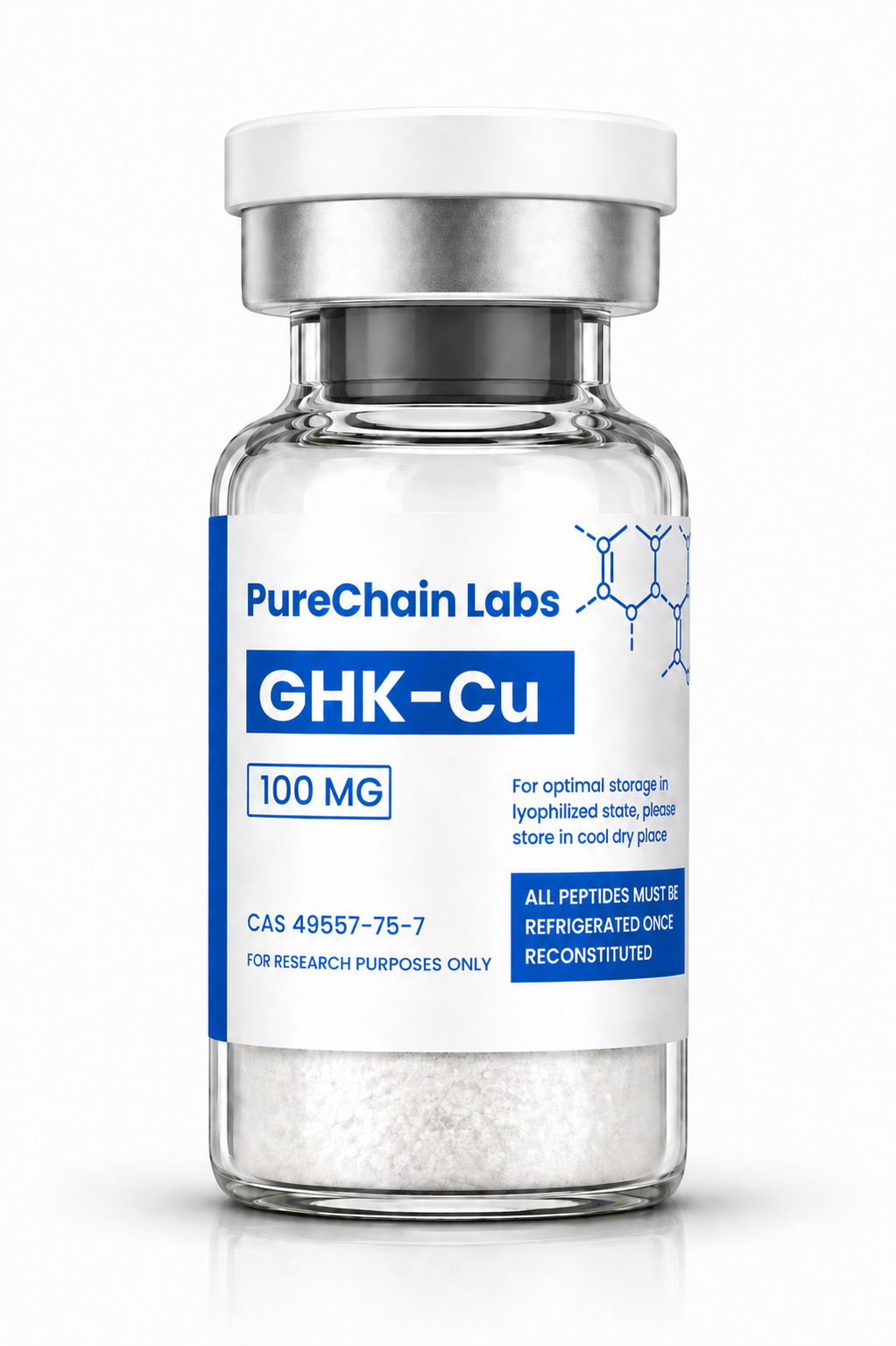
Every vial is labelled with its compound, vial size and molecular weight, and ships for laboratory research use only. Third-party testing details will be published here.
Supplied for in-vitro laboratory research only. Not for human or veterinary use, and not intended to diagnose, treat, cure or prevent any disease.
- Size
- 100mg
- Form
- Lyophilized powder
- Storage
- −20 °C, protected from light
- Molar mass
- 400.90 Da
About This Compound
About GHK-Cu
GHK-Cu is the tripeptide glycyl-histidyl-lysine bound to a copper(II) ion. The peptide occurs naturally in human plasma, where its concentration falls with age, and it binds copper with high affinity through its histidine imidazole and the terminal amine. That copper-carrying property is the whole point of the molecule in research: it is studied as a physiological shuttle that delivers copper to enzymes and as a signalling peptide in its own right, and it is one of the most heavily published small peptides in skin and wound-model literature.
Copper-Binding Tripeptide Complex
Molecular Formula
Molecular Weight
Form
Vial Size
02Molecular Structure
The GHK-Cu molecule
An illustrative atomic representation generated from the compound record, alongside its verified molecular data. The structure figure is schematic – not a measured conformation.
- C
- H
- N
- O
- S/P
Molecular data from the public PubChem record (CID 139035031). View on PubChem
By The Numbers
GHK-Cu Research, By The Numbers
The figures that define GHK-Cu and how it is being studied. For laboratory research use only.
Amino Acids
Glycine, histidine and lysine, with a bound copper(II) ion
Year First Isolated
Identified in human plasma as an albumin-associated factor
Bound Metal Ion
Coordinated by the histidine imidazole and the N-terminal amine
Research Areas
- Collagen And ECM Studies
- Wound-Model Repair
- Copper Transport
- Gene-Expression Profiling
How It Works
How GHK-Cu Works
The pathways GHK-Cu acts on, and what each one does. Described from preclinical and receptor-pharmacology literature.
A Physiological Copper Shuttle
The tripeptide binds copper(II) with an affinity close to that of albumin, which lets it exchange copper with plasma proteins and carry it to cells. Copper is a required cofactor for lysyl oxidase, superoxide dismutase and cytochrome c oxidase, so the complex is studied as a delivery route to those enzymes rather than as an inert carrier.
- Binds Cu(II) at an affinity comparable to albumin
- Exchanges copper with plasma binding proteins
- Copper is a cofactor for lysyl oxidase and SOD
Collagen And Extracellular Matrix Models
In fibroblast culture GHK-Cu is used to study the synthesis of collagen, elastin, glycosaminoglycans and proteoglycans, and the balance between matrix metalloproteinases and their tissue inhibitors. It is a standard positive control in extracellular-matrix work.
- Studied for collagen and elastin synthesis in fibroblast models
- Used in MMP / TIMP balance experiments
- A reference compound in ECM turnover assays
Broad Transcriptional Profiling
Published microarray work reports that GHK resets the expression of a large number of human genes towards a healthier pattern in cultured cells. That breadth is why the peptide appears in transcriptomic studies rather than only in matrix assays.
- Profiled by microarray across thousands of human genes
- Reported effects on both up- and down-regulated sets
- Used in transcriptomic as well as biochemical models
Uses And Applications
What GHK-Cu Is Researched For
The main areas GHK-Cu is studied in, and the qualitative magnitudes reported alongside them.
Collagen Synthesis Studies
The best-established research use. Fibroblast cultures treated with GHK-Cu are used to measure collagen and elastin production and to compare matrix-building compounds against each other.
Wound-Model Repair Research
Applied in animal and tissue wound models investigating angiogenesis, granulation tissue and the contribution of copper availability to repair.
Copper Homeostasis
Used as a tool for studying how copper moves between plasma proteins and cells, and what happens to copper-dependent enzymes when that supply is altered.
Skin Research
A reference peptide in dermal research, where the decline of plasma GHK with age is the starting observation for much of the published work.
Compound Information
Full Specification
| Chemical Name | Copper tripeptide-1 (glycyl-L-histidyl-L-lysine copper) |
|---|---|
| Sequence | Gly-His-Lys · Cu(II) |
| Molecular Weight | 400.90 Da |
| Molecular Formula | C14H21CuN6O4- |
| Form | Lyophilized powder |
| Solubility | Water-soluble |
| Storage | Store lyophilized at −20 °C, protected from light and moisture |
| Vial Size | 100mg |
| PubChem CID | 139035031 |
FAQ
Common Questions About GHK-Cu
What Is GHK-Cu?
GHK-Cu is the naturally occurring human tripeptide glycyl-histidyl-lysine complexed with a copper(II) ion. It was first isolated from human plasma in 1973 and is supplied here as a research compound.
Why Is The Copper Part Important?
Because the peptide is studied specifically as a copper carrier. Copper is an essential cofactor for enzymes including lysyl oxidase and superoxide dismutase, and much of the published research treats GHK-Cu as a physiological way of delivering it.
Is GHK-Cu The Same As GHK?
No. GHK is the bare tripeptide; GHK-Cu is that tripeptide with copper bound. They are studied both together and separately, because some reported activity depends on the metal and some does not.
Why Is GHK-Cu Used In Skin Research?
Plasma GHK concentration declines substantially with age, and the peptide has an extensive published record in collagen and extracellular-matrix models. That combination makes it a standard reference compound in dermal work.
Is GHK-Cu Approved For Human Use?
The material supplied here is a research chemical for in-vitro laboratory use only. It is not supplied for human or veterinary use in any form.
How Should Research-Grade GHK-Cu Be Stored?
Lyophilized GHK-Cu should be stored at −20 °C, protected from light and moisture. Copper complexes are sensitive to oxidation, so solutions should be kept cold and used promptly after reconstitution.
Feedback
WHAT OUR CUSTOMERS HAVE TO SAY...
"Been using PureChain Labs for 9 months now. In my opinion, it's the best source in Canada. Quality product every time and gives me the best results. Also the communication is second to none, I get a response in minutes usually. Overall extremely happy with the service and product they provide."
"A+ service and communication. Delivery is always quick and packaged safe and sound... I love how they are transparent and you know what your getting and for using a new source for the first time that's a huge relief."
"Took a month but hair felt thicker at roots, gave me hope after months of thinning, they definitely sell quality peptides."
Not for human or veterinary use. For in-vitro laboratory research only. These statements have not been evaluated by the FDA or Health Canada; this product is not intended to diagnose, treat, cure or prevent any disease.