

SS-31 10mg
SS-31 10mg
Couldn't load pickup availability
SS-31 10mg
Get it as soon as -
30 Day Trial
30 Day Trial
We're confident you'll be happy with your order! In case things don't go as planned, you have 30 days to request a refund based on our return and refund policy.
Shipping & Processing
Shipping & Processing
Our shipping services are designed to be fast and reliable, ensuring your order is delivered promptly. Please allow 5-10 business days for delivery.
Track My Order
Track My Order
Once your order is shipped, we will provide you with a tracking number to monitor the progress of your shipment on our website or the shipping carrier's website. You can track your order here Track My Order
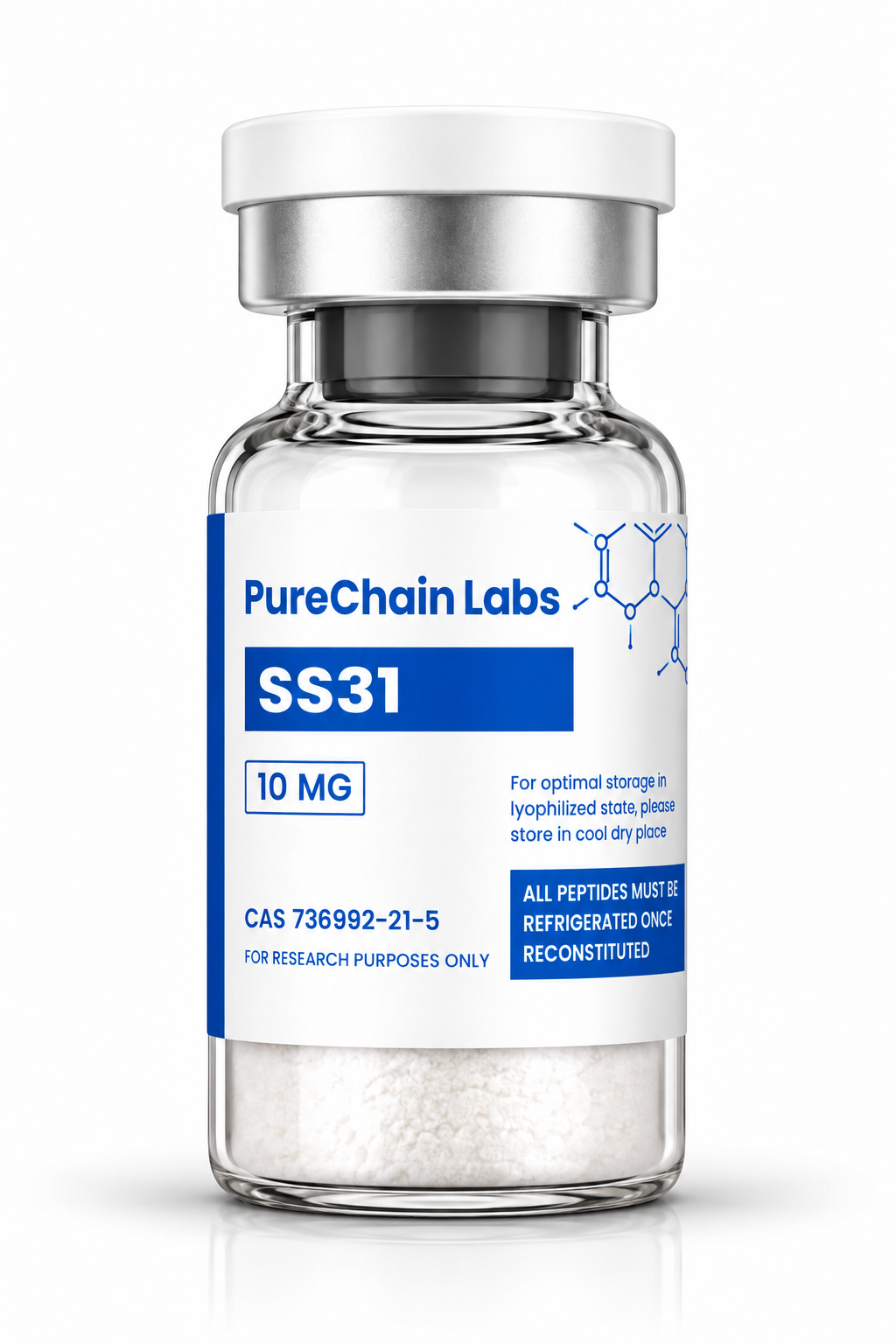
Each vial contains 50mg of lyophilized SS-31.
SS-31 (elamipretide) is a synthetic tetrapeptide (D-Arg-Dmt-Lys-Phe-NH2) that selectively binds cardiolipin in the inner mitochondrial membrane. It has been studied for its effects on mitochondrial membrane structure, electron transport, and reactive oxygen species production, and is widely used in mitochondrial and age-related research.
01The PureChain Standard
Purity And Documentation
Your results are only as good as the compound you start with.
Every vial is labelled with its compound, vial size and molecular weight, and ships for laboratory research use only. Third-party testing details will be published here.
Supplied for in-vitro laboratory research only. Not for human or veterinary use, and not intended to diagnose, treat, cure or prevent any disease.
- Size
- 10mg
- Form
- Lyophilized powder
- Storage
- −20 °C, protected from light
- Molar mass
- 639.8 Da
About This Compound
About SS-31
SS-31, also known as elamipretide, is a synthetic water-soluble tetrapeptide built on the Szeto-Schiller aromatic-cationic motif: alternating basic and aromatic residues, with 2',6'-dimethyltyrosine (Dmt) in the second position and a D-arginine at the N-terminus. That alternating charge pattern is what distinguishes the SS series from ordinary short peptides - it carries a 3+ charge at physiological pH yet still crosses membranes, and it concentrates in the inner mitochondrial membrane without depending on the membrane potential to get there. Research interest centres on its association with cardiolipin, the signature phospholipid of that membrane. PureChain Labs supplies SS-31 as a lyophilised powder for in-vitro laboratory research only.
Mitochondria-Targeted Cardiolipin-Binding Tetrapeptide
Molecular Formula
Molecular Weight
Form
CAS Number
02Molecular Structure
The SS-31 molecule
An illustrative atomic representation generated from the compound record, alongside its verified molecular data. The structure figure is schematic – not a measured conformation.
- C
- H
- N
- O
- S/P
Molecular data from the public PubChem record (CID 11764719). View on PubChem
By The Numbers
SS-31 Research, By The Numbers
The figures that define SS-31 and how it is being studied. For laboratory research use only.
Amino Acids
An aromatic-cationic tetrapeptide of the Szeto-Schiller series
Binding Partner Studied
Associates with cardiolipin in the inner mitochondrial membrane
Molecular Weight (g/mol)
C32H49N9O5, PubChem CID 11764719
Research Areas
- Mitochondrial Bioenergetics
- Cristae Architecture Studies
- Oxidative Stress Models
- Ischaemia-Reperfusion Research
How It Works
How SS-31 Works
The pathways SS-31 acts on, and what each one does. Described from preclinical and receptor-pharmacology literature.
Inner Membrane Targeting
SS-31 is studied for its selective association with cardiolipin, a four-tailed phospholipid found almost exclusively in the inner mitochondrial membrane. Unlike cationic carriers that rely on the membrane potential, uptake in published models is reported to be potential-independent, which is why it remains a tool compound of interest in depolarised mitochondria.
- A 4-residue Szeto-Schiller aromatic-cationic peptide
- Associates with cardiolipin in the inner membrane
- Uptake reported as membrane-potential independent
Membrane Curvature And Supercomplexes
Cardiolipin helps hold the curvature of the cristae and the assembly of respiratory chain supercomplexes. Research examines whether peptide binding changes that organisation, and what follows for electron transport efficiency in the models used.
- Cardiolipin supports cristae curvature
- Involved in respiratory supercomplex assembly
- Imaging and EM are the usual endpoints
Oxidative Stress Endpoints
A recurring endpoint in the literature is whether electron leak from the respiratory chain, and the reactive oxygen species produced by it, differ in treated preparations. These are measurements made in experimental systems, not claims about any outcome.
- Electron leak is measured, not asserted
- Reactive oxygen species are the readout
- Findings are model-specific
Uses And Applications
What SS-31 Is Researched For
The main areas SS-31 is studied in, and the qualitative magnitudes reported alongside them.
Mitochondrial Bioenergetics
The primary research use. SS-31 is a standard tool compound for probing cardiolipin-dependent effects on respiration in isolated mitochondria and permeabilised cells.
Cristae Structure Studies
Used in electron-microscopy and imaging work examining inner membrane organisation.
Oxidative Stress Models
Applied in cell models where reactive oxygen species generation is the measured endpoint.
Peptide Delivery Research
The aromatic-cationic motif itself is studied as a membrane-targeting scaffold, independent of any downstream effect.
Compound Information
Full Specification
| Chemical Name | Elamipretide (SS-31) |
|---|---|
| Sequence | D-Arg-Dmt-Lys-Phe-NH2 |
| Molecular Weight | 639.8 Da |
| Molecular Formula | C32H49N9O5 |
| CAS Number | 736992-21-5 |
| Form | Lyophilized powder |
| Solubility | Water-soluble |
| Storage | Store lyophilized at −20 °C, protected from light and moisture |
| Vial Size | 10mg |
| PubChem CID | 11764719 |
FAQ
Common Questions About SS-31
What Is SS-31?
SS-31, or elamipretide, is a synthetic tetrapeptide of the Szeto-Schiller aromatic-cationic series with the sequence D-Arg-Dmt-Lys-Phe-NH2. PubChem lists it under CID 11764719 with the formula C32H49N9O5 and a molecular weight of 639.8 g/mol.
Why Is It Called Aromatic-Cationic?
The sequence alternates basic residues (D-arginine, lysine) with aromatic ones (2',6'-dimethyltyrosine, phenylalanine). That alternation is the structural feature the SS series is named for and is what the membrane-targeting research focuses on.
What Is Cardiolipin?
Cardiolipin is a phospholipid with four acyl chains, found almost exclusively in the inner mitochondrial membrane, where it supports membrane curvature and the assembly of respiratory chain complexes. It is the binding partner most often studied for SS-31.
Does SS-31 Need A Membrane Potential To Enter Mitochondria?
Published work reports uptake that does not depend on the membrane potential, which distinguishes it from classic lipophilic cations. That is a reported property of the models used, not a guarantee of behaviour in any other system.
Is SS-31 Approved For Human Use?
No. Nothing supplied by PureChain Labs is approved for human use or sold for it. This material is supplied as a research chemical for in-vitro laboratory work only.
How Should Research-Grade SS-31 Be Stored?
As supplied it is a lyophilised powder; the vial directs storage in a cool, dry place in the lyophilised state, and refrigeration once reconstituted.
Feedback
WHAT OUR CUSTOMERS HAVE TO SAY...
"Been using PureChain Labs for 9 months now. In my opinion, it's the best source in Canada. Quality product every time and gives me the best results. Also the communication is second to none, I get a response in minutes usually. Overall extremely happy with the service and product they provide."
"A+ service and communication. Delivery is always quick and packaged safe and sound... I love how they are transparent and you know what your getting and for using a new source for the first time that's a huge relief."
"Took a month but hair felt thicker at roots, gave me hope after months of thinning, they definitely sell quality peptides."
Not for human or veterinary use. For in-vitro laboratory research only. These statements have not been evaluated by the FDA or Health Canada; this product is not intended to diagnose, treat, cure or prevent any disease.